
Halfway Through the Century: Can Developing Economies Regain Momentum?
The Global Economic Prospects: January 2025 report by the World Bank offers a sobering but constructive reflection on the global economy’s trajectory at the close of the first quarter of the 21st century. While global growth is projected to stabilize at 2.7% through 2025–2026, the report’s central message is clear: this level of growth is insufficient to drive meaningful global development, reduce poverty at scale, or enable low-income countries (LICs) and emerging market and developing economies (EMDEs) to catch up to advanced economies.
At the heart of the report is a candid recognition of both the progress made and the setbacks encountered by developing countries. Over the past 25 years, EMDEs rose significantly, accounting for nearly half of global GDP—up from just 25% in 2000—and driving 60% of global growth. However, much of this dynamism faded after the 2008–09 Global Financial Crisis. Growth decelerated, investment slowed, and gains in per capita income relative to advanced economies stagnated or reversed in many cases. Especially troubling is the stalled trajectory of the world’s poorest economies: only six of today’s 26 LICs are likely to achieve middle-income status by 2050.
The report lays out multiple reasons for this reversal of fortune. Geopolitical tensions, slowing global trade, rising protectionism, and climate-related shocks are compounded by internal challenges: high public debt, stalled domestic reforms, underinvestment in human capital, and limited fiscal space. While inflation is easing globally and monetary policy has turned more accommodative, the benefits are tempered by risks of policy uncertainty, potential trade disruptions, and weak productivity growth.
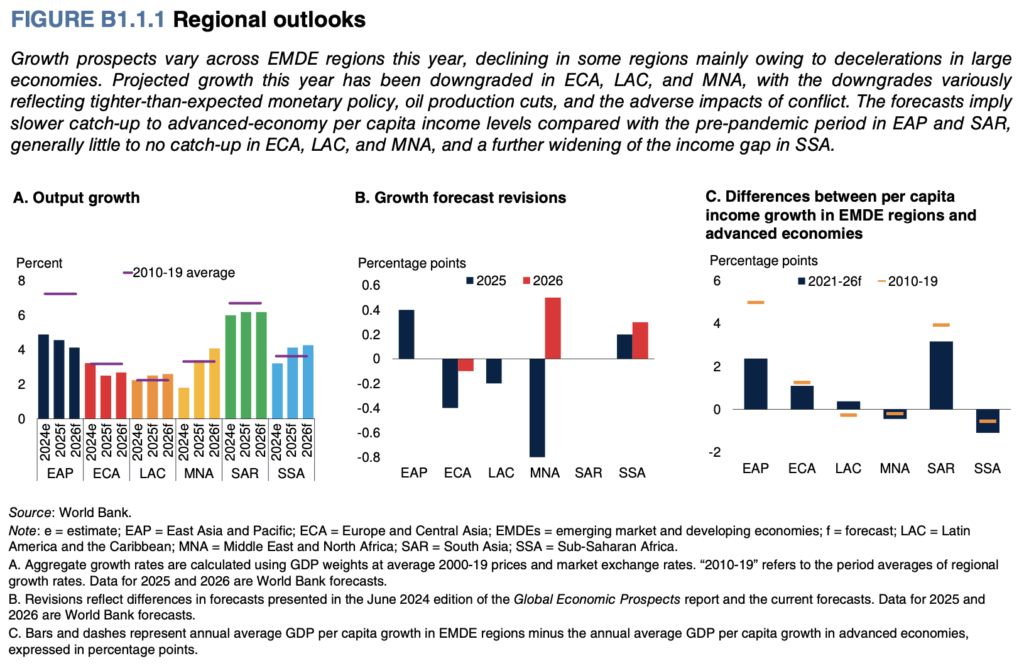
The World Bank rightly emphasizes the need for urgent, decisive, and tailored policy action. Globally, this means recommitting to trade openness, supporting concessional financing for LICs, and intensifying efforts to combat climate change. Nationally, countries must strengthen institutions, invest in infrastructure and education, and enact reforms that boost productivity and inclusive growth. Particular attention is needed to address the unique vulnerabilities of conflict-affected and fragile states, where growth has nearly halted.
Despite the grim outlook, the report identifies new opportunities—especially through greater South-South cooperation. Trade between developing countries has doubled since 2000, and economic spillovers from large EMDEs like China, India, and Brazil now rival those from advanced economies. These shifts suggest that developing economies can increasingly shape their own futures, provided they strengthen regional ties and diversify their growth strategies.
Ultimately, the report serves as both a wake-up call and a policy blueprint. The goals of 2030 may not be fully realized, but with renewed commitment and coordinated action, developing economies can still reverse current trends and achieve sustainable, inclusive growth in the decades ahead.
Cover photo source: https://openknowledge.worldbank.org/server/api/core/bitstreams/f983c12d-d43c-4e41-997e-252ec6b87dbd/content
- By Strategers