
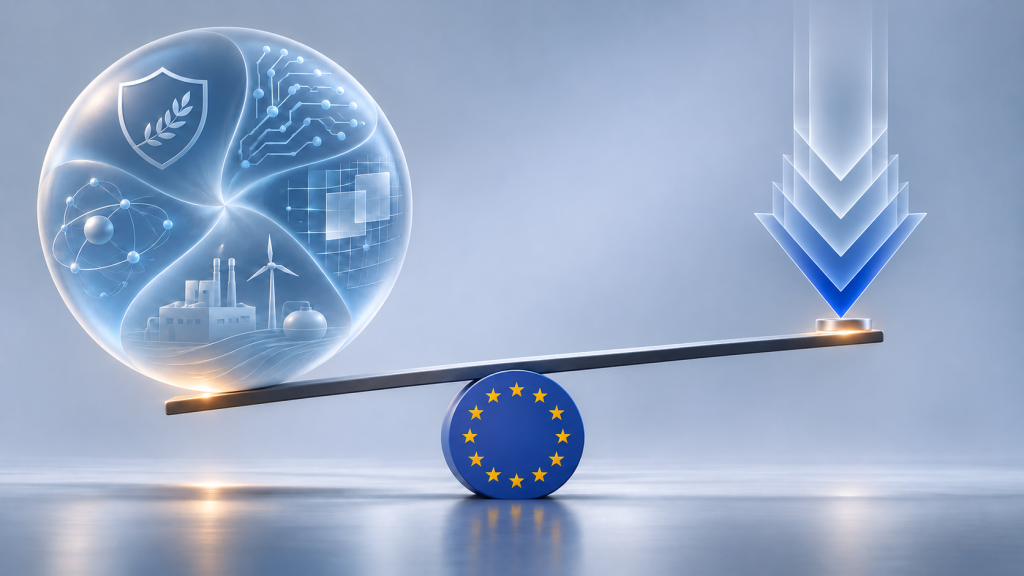
The Levers of Power
“Power may be defined as the production of intended effects.”— Bertrand Russell
Influence depends on knowing which levers to pull and having the strength to move them. Across security, AI, digital markets, industrial climate policy and research alliances, this edition examines whether Europe can turn its rules, partnerships and ambitions into strategic weight.
1. Dublin Declaration Sets Common Principles for Ukraine’s Peace and European Security
Forty European countries, including North Macedonia, signed a declaration affirming that Ukraine must participate in determining its path to peace and that decisions affecting European security require European involvement. Adopted at the European Political Community summit in Dublin, it supports Ukraine’s sovereignty, territorial integrity and right to choose its alliances, while calling for credible security guarantees against renewed aggression. The declaration is neither a peace agreement nor a binding defence commitment. Its importance lies in establishing common European boundaries for negotiations at a moment when the continent risks being sidelined in decisions directly affecting its future security architecture.
Sources: European Political Community summit
2. First AI Summit Confronts Europe’s Competitiveness and Technology Gap
EU leaders gathered in Dublin for their first dedicated strategic discussion on artificial intelligence, examining how Europe can narrow its technology gap with the United States and China. Discussions covered investment, computing infrastructure, affordable energy, industrial adoption and the need to reduce critical dependencies across the AI value chain. Leaders also considered cybersecurity, democratic integrity, children’s rights, employment and the concentration of technological power among a small number of companies. But Europe’s real challenge comes after the summit: it has developed an extensive regulatory framework without yet securing the investment, infrastructure and globally competitive companies required for genuine AI sovereignty.
Sources: Reuters – EU leaders tackle challenges at first AI summit
3. Digital Fairness Act Targets Addictive Design and Online Manipulation
The European Commission proposed a Digital Fairness Act to protect consumers from manipulative practices used by online platforms and digital businesses. The proposal targets dark patterns, fake urgency, hidden fees, subscription traps, undisclosed influencer advertising and personalised commercial practices that exploit minors or sensitive personal data. Consumers would receive greater control over addictive features, clearer information about dynamic prices and virtual currencies, and simpler ways to cancel digital subscriptions. A parallel enforcement reform would allow the Commission to investigate major cross-border cases directly and impose fines of up to 6% of a company’s worldwide annual turnover. The proposal could reshape how digital businesses compete for consumers’ money and attention. However, it must still pass through negotiations with the European Parliament and Council, meaning its final protections and enforcement powers are not guaranteed.
Sources: European Commission – Digital Fairness Act proposal
4. Carbon Rules Eased to Protect Energy-Intensive Industries
The Council and European Parliament reached a provisional agreement to increase free carbon allowances for energy-intensive industries between 2026 and 2030. Approximately 121 million allowances will provide additional protection for industries at risk of “carbon leakage”—the relocation of production to countries with weaker environmental requirements. The measure is intended to preserve industrial competitiveness while companies invest in cleaner production. Yet it also reveals a difficult contradiction within the green transition: giving industries more free allowances may prevent production and jobs from leaving Europe, but it can also weaken the carbon-price pressure intended to accelerate decarbonisation. The central question is therefore no longer simply whether Europe can reduce emissions, but whether it can do so without losing the industrial capacity needed to sustain its economy and strategic autonomy.
Source: Council of the EU – Agreement on free carbon allowances
5. Australia Joins Europe’s Research and Innovation Ecosystem
The EU and Australia signed an agreement allowing Australian researchers and organisations to participate in and lead collaborative projects under Horizon Europe. From 2027, they will be able to access the programme’s €52.4 billion Pillar II, which supports cooperation in digital technologies, industry, space, health, climate, energy and food systems. Australian participants will operate under conditions similar to those applying to European organisations, creating new opportunities for universities, researchers and innovative businesses. Australia becomes the 24th country associated with Horizon Europe, further expanding the programme beyond the EU’s geographical borders. The agreement is more than an academic partnership. By connecting trusted research systems across continents, the EU is building a broader network around scientific cooperation, technological competitiveness and economic security at a time when access to knowledge and innovation is increasingly geopolitical.
- By Strategers