
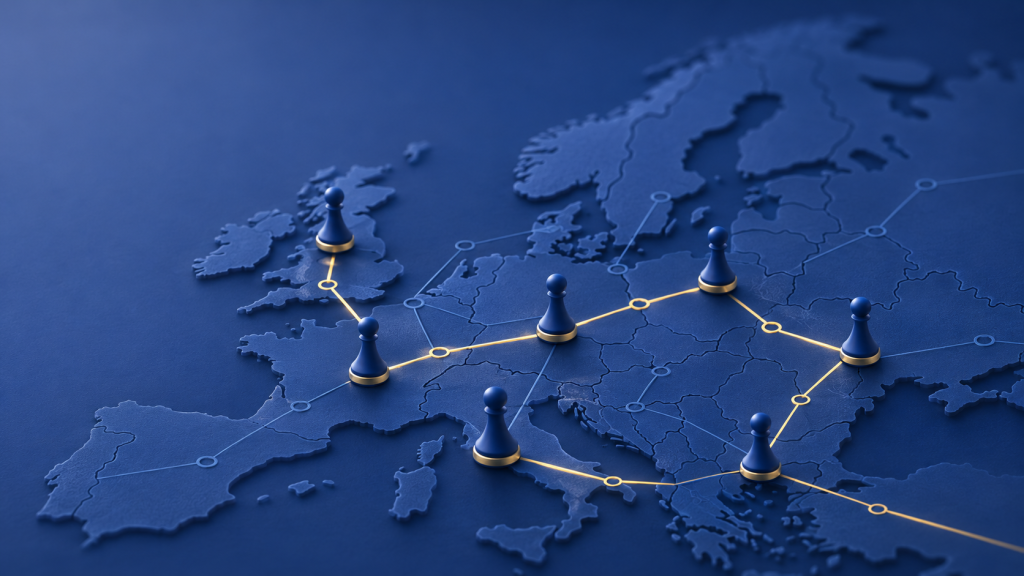
The Pattern Behind the Moves
“Strategy is a pattern in a stream of decisions.”— Henry Mintzberg
From rebuilding ties with Britain and sustaining Ukraine, to bringing Montenegro closer, diversifying trade and preparing people for AI, this week’s developments reveal a broader pattern. Europe is trying to strengthen its position by investing in alliances, economic resilience, enlargement and the capabilities it will need to remain relevant.
1. Brussels Reframes Enlargement as a Strategic Investment
At the EU Enlargement Forum in Brussels, European and candidate-country leaders presented enlargement as an investment in Europe’s security, economic strength and ability to act—not simply as a promise to countries waiting to join. Discussions focused on gradual integration, reforms and investment, as well as the institutional changes the EU will need before welcoming additional members. President von der Leyen called for candidate countries to receive some benefits of integration before full membership, including greater participation in the Single Market in return for reforms. North Macedonia was specifically recognised for its implementation of the Growth Plan, while Montenegro’s continued closure of negotiating chapters demonstrated how reform progress can produce tangible movement.
Sources: European Commission – EU Enlargement Forum 2026
2. EU and UK seal a new post-Brexit partnership
The European Union and the United Kingdom have concluded agreements covering food trade, emissions trading and youth mobility. Most certificates and checks on agricultural and food products will be removed from March 2028, while the two emissions-trading systems will be linked to protect businesses from reciprocal carbon-border charges. A new Youth Experience Scheme will allow up to 100,000 young people from each side to live, work, study, volunteer or travel for three years. Cooperation will also expand in defence, cybersecurity, military mobility, migration and strategic supply chains. University tuition fees remain unresolved, but the summit marks the clearest shift towards closer EU–UK relations since Brexit.
Sources: Council of the EU – Joint statement | Reuters
3. EU proposes €45 billion in additional support for Ukraine
The European Commission has proposed a new loan of up to €45 billion to support Ukraine in 2027, covering approximately two-thirds of the country’s estimated €70 billion financing gap. The loan would be financed through EU borrowing and repaid through future reparations owed by Russia. The proposal comes alongside the disbursement of €7.9 billion under existing EU instruments and an additional €1 billion for military equipment. It demonstrates that European support is moving beyond emergency assistance towards financing Ukraine’s long-term economic stability, defence and reconstruction. However, the new loan still requires the approval of EU member states, making European unity essential to its implementation.
Sources: European Commission – €45 billion proposal | Reuters
4. EU–Indonesia trade agreement strengthens economic diversification
The Council has authorised the signature and provisional application of comprehensive trade and investment agreements with Indonesia, Southeast Asia’s largest economy. Once fully implemented, the partnership will liberalise up to 98.5% of tariff lines, remove 96% of Indonesian tariffs within five years and save businesses approximately €600 million annually. The agreements cover agriculture, automotive manufacturing, pharmaceuticals, machinery, digital trade, energy and raw materials. For Europe, the partnership provides access to a growing Indo-Pacific market while supporting efforts to reduce dependence on a limited number of suppliers. The European Parliament must still approve the agreements, while environmental concerns surrounding deforestation and resource extraction will remain an important part of the debate.
Source: Council of the EU – EU–Indonesia trade and investment agreements
5. Europe links AI investment with education and skills
The European Commission has opened €297 million in Horizon Europe funding calls covering frontier AI, robotics, energy-efficient AI processing, photonics and emerging digital technologies. The investment is intended to strengthen Europe’s technological sovereignty and reduce dependence on non-European providers. At the same time, EU education ministers approved conclusions calling for AI literacy to be incorporated into curricula, teacher training, vocational education and lifelong learning. Universities and vocational providers are encouraged to adapt programmes to emerging occupations and help people use AI critically, safely and responsibly. The conclusions are not legally binding, meaning their impact will depend on national investment and implementation.
Sources: European Commission – €297 million for digital technologies | Council of the EU – AI skills and education
- By Strategers