
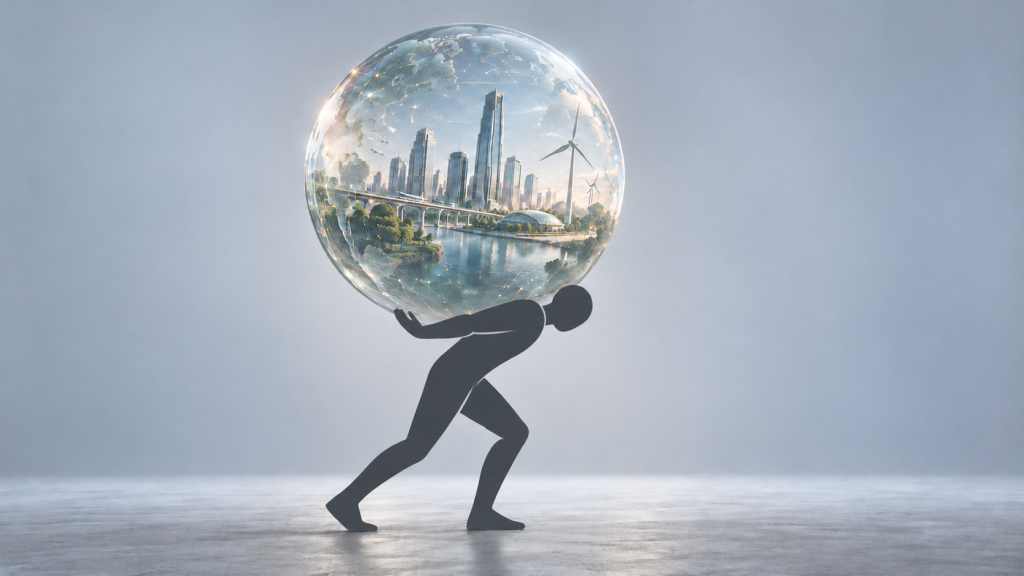
The Weight of Tomorrow
“Nothing is possible without people. Nothing is lasting without institutions.” — Jean Monnet
Every advance creates new possibilities, but also new pressures and vulnerabilities. Enlargement gathers momentum, Europe’s ambitions strain against political limits, and AI drives growth while exposing financial and cyber risks. These five stories look beyond the promise of progress and ask whether today’s systems are strong enough to carry tomorrow’s ambitions.
1. Four Candidates, Four Steps Forward
EU enlargement recorded unusually broad progress this week through accession conferences with Montenegro, Albania, Ukraine and Moldova. Montenegro provisionally closed three additional chapters—economic and monetary policy, statistics, and social policy and employment—bringing its total to 21 of 33 chapters. Albania closed negotiations on enterprise and industrial policy, its fourth provisionally closed chapter. Ukraine and Moldova, meanwhile, opened negotiations on the internal market and competitiveness and inclusive growth clusters, covering 17 chapters for each country. The meetings demonstrate renewed momentum behind enlargement, but they also reveal an increasingly differentiated process in which candidates advance according to their reform performance and political readiness.
Source: European Commission
2. Europe’s Priorities Collide at a Single Summit
EU leaders gathered in Brussels as energy insecurity, industrial pressure and geopolitical tensions converged on the European agenda. Discussions focused on lowering energy costs, responding to growing trade imbalances with China, maintaining support for Ukraine and financing the Union’s priorities through its 2028–2034 budget. Yet governments remain divided over the budget’s overall size and how funding should be distributed between agriculture, regional development, competitiveness, defence and emerging strategic needs. The summit exposed Europe’s central dilemma: the Union wants to strengthen its economy, security and global influence simultaneously, but member states have yet to agree on how these ambitions should be financed—or which should come first.
Source: European Council meeting, 15–16 October 2026
3. AI Supports Global Growth—but Also Magnifies the Risks
The IMF projects global growth of 3.1% in 2026 and 3.4% in 2027, with strong investment in artificial intelligence infrastructure helping to offset energy shocks and wider economic weakness. However, the same AI boom supporting growth is also becoming a source of financial vulnerability. The IMF warned that optimistic earnings expectations, heavily leveraged investments and doubts about the profitability of data centres could trigger a correction in AI-related markets. Global inflation is expected to reach 4.7% this year, while high public debt leaves many governments with limited room to respond to another major shock. The outlook therefore depends increasingly on whether today’s enormous AI investments translate into sustainable productivity gains.
Source: IMF – October 2026 World Economic Outlook
4. When a Cyberattack Reaches the Supermarket Aisle
A large-scale cyberattack targeting connected refrigeration systems raised temperatures in French supermarket refrigerators and freezers to as high as 50°C, causing fires and destroying food. Approximately 150 Intermarché stores were affected, while related incidents were identified in several other European countries. The attack demonstrated how weaknesses in connected devices can turn a digital breach into immediate physical and economic damage. Days later, G7 finance leaders agreed to conduct joint simulations of AI-enabled cyberattacks against financial institutions. Together, the developments signal a new phase in cybersecurity: threats are no longer limited to stolen data or disabled websites—they can disrupt food supplies, essential infrastructure, financial services and public confidence.
Sources: Reuters – Cyberattack targets supermarket refrigeration systems
5. Nobel Prize Honours the Ideas Behind Modern Economic Policy
American economists Robert E. Hall and Michael Woodford received the 2026 Nobel Prize in Economic Sciences for research that transformed how governments and central banks respond to inflation, recessions and economic shocks. Their work connected broader economic outcomes with the expectations and everyday decisions of households and businesses, helping establish concepts such as forward guidance, sticky inflation and the output gap. These ideas now underpin many of the models used to guide interest-rate and fiscal-policy decisions. The award is particularly timely as policymakers confront another period of energy-driven inflation, elevated borrowing costs and uncertainty over how consumers, businesses and markets will react.
Sources: Official Nobel Prize announcement
LinkedIn:
https://www.linkedin.com/pulse/weight-tomorrow-strategersinstitute-sppnf/?trackingId=WMmg52yOSOKoUfZ82oF%2BAw%3D%3D
- By Strategers