
The Economics of Thinking Ahead: What Hall and Woodford Teach Us About Prosperity
Economic crises are never purely economic. Recessions destroy jobs and businesses, inflation erodes purchasing power, and prolonged uncertainty weakens trust in institutions. Stabilising the economy is therefore not merely a technical exercise – it is a condition for shared prosperity.
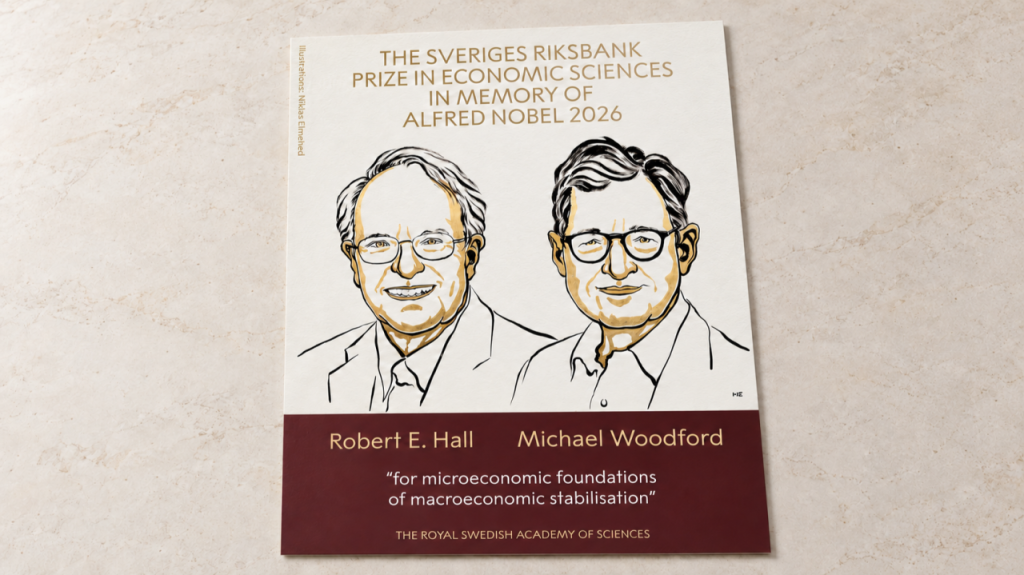
The 2026 Sveriges Riksbank Prize in Economic Sciences recognises Robert E. Hall and Michael Woodford “for microeconomic foundations of macroeconomic stabilisation.” Their achievement was to connect the economy’s biggest movements – booms, recessions and inflation – to millions of individual decisions made by households and businesses. Together, they helped transform stabilisation policy from a system based largely on historical correlations into one grounded in economic behaviour and expectations.
Robert Hall: Why consumption is about tomorrow
Older models often treated household consumption as a predictable response to current income: when income rises, people spend more; when it falls, they spend less. Hall showed that the relationship is more subtle. Households also consider their expected future earnings, accumulated wealth, debts and access to credit. A family expecting years of stable income may continue spending through a temporary setback. Another family, with no savings or borrowing capacity, may have to reduce consumption immediately. Under Hall’s framework, consumption changes mainly when new information alters expectations about the future. This means consumer spending is inherently difficult to forecast from past information alone.
That insight has important policy consequences. A temporary tax rebate may generate little additional demand if financially secure households save it. The same support directed toward liquidity-constrained families may be spent immediately. The effect of fiscal policy therefore depends not only on its size, but also on its design and recipients.
Michael Woodford: Monetary policy works through expectations
Woodford developed a comprehensive framework connecting household decisions, firms’ price-setting behaviour and central-bank interest-rate policy. Businesses do not continuously change prices whenever costs or demand move. Prices are often “sticky” because changing them can be costly, disruptive or strategically unwise. This creates space for monetary policy to affect real economic activity, at least in the short run. But Woodford’s deeper message is that interest rates are only part of the story. What households, firms and investors expect central banks to do tomorrow can influence spending, investment and prices today.
A credible commitment to future policy may therefore be as consequential as the current interest-rate decision. This intellectual framework, developed most fully in Woodford’s Interest and Prices, became a foundation of modern New Keynesian models used by central banks and finance ministries around the world. The Nobel Committee describes the combined work as a new foundation for understanding the forces behind recessions and booms.
Five lessons for policymakers
1. Expectations are an economic force. Policy affects behaviour partly through what it signals about the future. Clear communication is therefore not public relations added to policy; it is one of the channels through which policy operates.
2. Credibility is a form of economic capital. Forward guidance works only when people believe institutions can and will deliver. Independence, consistency and transparency allow central banks and governments to influence expectations with fewer disruptive interventions.
3. Households are not interchangeable. Some can smooth consumption through savings or borrowing, while others live from one paycheque to the next. Fiscal measures should account for these differences. Targeting can matter as much as the total amount spent.
4. Supply shocks involve genuine trade-offs. When an energy shock raises inflation while weakening output, policymakers cannot assume that stimulating demand will solve both problems. They must assess the shock’s source, persistence and distributional effects—and communicate the unavoidable compromises honestly.
5. Models are decision tools, not crystal balls. Hall’s work itself warns against excessive confidence in forecasts. The value of a model lies less in producing one precise prediction than in organising evidence, testing assumptions and comparing possible policies.
From theory to real-world resilience
Hall and Woodford did not eliminate economic crises. No model can prevent pandemics, wars, energy disruptions or financial panics. Their contribution was to give policymakers a more coherent way to understand how such shocks spread—and how intervention can either dampen or amplify them. Their influence is visible in inflation targeting, interest-rate rules, forward guidance, fiscal-impact analysis and the economic models used to evaluate alternative responses to downturns. Their work shaped the policy frameworks applied during the global financial crisis, the pandemic and subsequent energy and inflation shocks.
The larger lesson for prosperity is simple: macroeconomic stability begins at the human level. People act on expectations. Businesses respond to incentives and uncertainty. Institutions influence both through their choices and their credibility. Prosperity cannot be reduced to smoothing every fluctuation. But societies are more capable of investing, innovating and sharing opportunity when severe economic instability does not repeatedly erase hard-won progress. Hall and Woodford helped explain how thoughtful, credible policy can make that stability more attainable.
References
https://www.nobelprize.org/prizes/economic-sciences/2026/press-release/
https://www.nobelprize.org/prizes/economic-sciences/2026/popular-information/
https://www.nobelprize.org/uploads/2026/10/advanced-economicsciencesprize2026.pdf

Fatmir BESIMI
Professor of Economics, South East European University, North Macedonia
President of Board, Strategers