
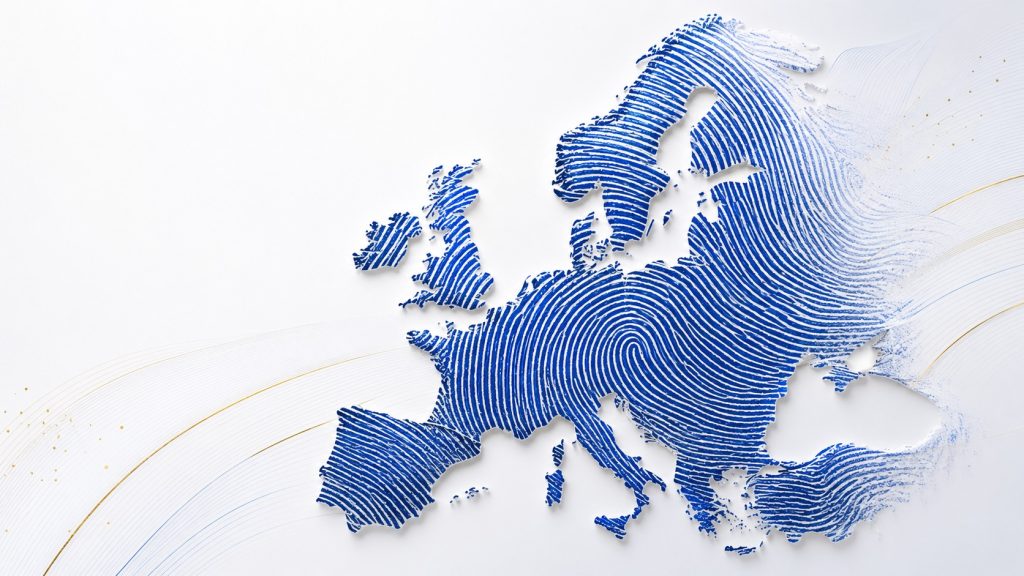
Europe Day 2026: The Strategic Fingerprint
Reaffirming the European Vision in a Fragmented Global Order
Europe Day 2026 reminds us that Europe’s strategic fingerprint is not only found in its history of peace and integration, but in its capacity to leave a distinct mark on the future: through unity in crisis, resilience in uncertainty, democratic strength, economic competitiveness and a renewed responsibility to shape the global order.
Europe Day is more than a commemoration of the Schuman Declaration. It is a reminder that the European project was born from crisis, courage and strategic imagination. In 1950, Europe responded to the devastation of war not with revenge or isolation, but with integration. Coal and steel, once instruments of military power, became foundations of shared peace. From that vision emerged the European Union: one of the most ambitious political, economic and institutional projects in modern history.
In my Europe Day reflection of 2025, I argued that the EU stood at a geopolitical and economic crossroads, facing war on its eastern border, strategic competition between global powers, energy vulnerabilities, defence gaps and the need for strategic sovereignty (Besimi, 2025). One year later, on Europe Day 2026, that crossroads has become even sharper. The question is no longer whether Europe must adapt. The question is whether Europe can act with the unity, speed and ambition required by the new global order.
The world around Europe is becoming more fragmented, more competitive and more uncertain. Russia’s war against Ukraine continues to define the security landscape of the continent. Instability in the Middle East has again reminded Europe that energy, inflation and geopolitics are deeply connected. Strategic competition between the United States and China is reshaping trade, technology, supply chains and global influence. At the same time, democratic societies face pressures from polarisation, disinformation, populism and declining trust in institutions.
This is the new reality of Europe: security is economic, economics is geopolitical, technology is power, and democracy is strategic infrastructure. Europe can no longer rely only on the instruments that made it successful in the past. Regulation, diplomacy, market integration and soft power remain essential, but they are no longer sufficient. The EU must now become a strategic actor: politically united, economically competitive, technologically sovereign, militarily credible and morally anchored.
The European Commission’s 2026 Work Programme captures this shift by framing the Union’s priorities around building a “strong, secure, and prosperous Europe” (European Commission, 2025a). Its agenda connects competitiveness, security, democracy, social fairness, global partnerships and institutional reform. This is the correct strategic direction. But the real test for Europe is not the formulation of priorities. It is implementation. Europe has often been strong in vision, but slower in execution. In today’s world, delay itself becomes a strategic risk.
Security is the first pillar of this new European moment. The EU was founded as a peace project, but peace requires the capacity to deter aggression. The White Paper for European Defence — Readiness 2030 recognises that Europe must close capability gaps, strengthen its defence industry, deepen joint procurement and build credible readiness by 2030 (European Commission, 2025b). This does not mean replacing NATO. It means strengthening Europe’s contribution to collective security and ensuring that Europe can act when its borders, interests and values are at stake.
European defence is not only a military question. It is also an industrial, technological and fiscal question. Defence readiness requires investment in air defence, cyber security, space, drones, artificial intelligence, military mobility and critical infrastructure. The wars of the future will not be fought only with traditional weapons. They will also be fought through satellites, data, energy grids, cyber systems, information flows and industrial capacity. Strategic autonomy is therefore not a slogan. It is the ability to decide, finance, produce and act.
The second pillar is competitiveness. A geopolitical Europe cannot be built on weak growth, fragmented capital markets and declining productivity. The IMF’s April 2026 Regional Economic Outlook warns that Europe is facing a new energy-driven supply shock linked to the war in the Middle East, with weaker investment and consumption, higher inflationary pressures and euro area growth projected at only 1.1 percent in 2026 (International Monetary Fund, 2026). This is not simply a macroeconomic forecast. It is a political warning. Without stronger growth, Europe will struggle to finance defence, enlargement, the green transition, digital transformation and social cohesion.
Competitiveness must therefore become a central European priority. The Draghi report on European competitiveness argued that Europe must address productivity gaps, high energy costs, investment shortages and global industrial competition (Draghi, 2024). The Letta report similarly called for a deeper and more integrated Single Market that can support scale, innovation and strategic resilience (Letta, 2024). The lesson is clear: Europe cannot achieve sovereignty without economic strength, and it cannot achieve economic strength without investment, innovation and integration.
The third pillar is technology and industrial capacity. Europe has world-class universities, strong companies, scientific excellence and regulatory influence. But too often, it regulates technologies that are scaled elsewhere. In artificial intelligence, semiconductors, clean energy, biotechnology, quantum technologies and space systems, Europe must become not only a rule-maker, but also a producer and innovator. The green and digital transitions should not be viewed only as costs. They are opportunities to build the next generation of European prosperity.
The fourth pillar is democracy and values. Europe’s deepest comparative advantage remains its democratic model: rule of law, human dignity, pluralism, social protection and institutional accountability. But values must be matched by delivery. Citizens will defend democracy when democracy provides security, prosperity, fairness and opportunity. A competitive Europe should not mean a less social Europe. It should mean a more productive, innovative and inclusive Europe, where growth strengthens social cohesion rather than weakening it.
This is especially important in the context of enlargement. Enlargement is no longer only a technical accession process. It is a geopolitical necessity. For the Western Balkans, Ukraine, Moldova and other candidate countries, the European perspective remains the strongest framework for democratic transformation, institutional reform and economic convergence. The EU Growth Plan for the Western Balkans aims to bring forward some benefits of membership, accelerate reforms and support economic convergence with the Union (European Commission, 2024). For the Western Balkans, whose income convergence remains far below the EU average, this is both an economic and strategic imperative.
But enlargement must be credible on both sides. Candidate countries must deliver reforms in rule of law, governance, public administration, anti-corruption, competitiveness and regional cooperation. The EU must provide predictability, gradual integration and a clear political horizon. The Western Balkans cannot remain permanently in Europe’s waiting room. Strategic ambiguity creates space for external influence, domestic frustration and democratic erosion. Enlargement is not charity. It is an investment in Europe’s security, stability and economic depth.
Europe’s global role must therefore evolve. For decades, the EU was described as a normative power, shaping the world through standards, trade, development assistance and diplomacy. That role remains important, but it is no longer enough. In the world of 2026, Europe must combine norms with power, openness with resilience, climate ambition with industrial strategy, diplomacy with deterrence and values with delivery.
Europe should not seek power for domination. It should seek power for balance: to defend peace, support development, protect democratic values, manage global public goods and offer a model of prosperity based on freedom, responsibility and solidarity.
The world needs a Europe that is open but not naïve, principled but not passive, peaceful but not powerless.
Europe Day 2026 should therefore be a moment of memory, but also of mobilisation. The founding generation built Europe to make war unthinkable. Our generation must build Europe to make peace sustainable, prosperity shared and democracy resilient in a world of power politics.
The European Union remains one of the greatest achievements of modern history. But every generation must renew the project it inherits. On Europe Day 2026, the message is clear: Europe must not only remember its vision. It must rise to it.
References
Besimi, F. (2025). Europe Day: Reaffirming the Union’s vision in a shifting global order. Prosperity Review, LinkedIn Newsletter.
Draghi, M. (2024). The future of European competitiveness. European Commission.
European Commission. (2024). Growth Plan for the Western Balkans. European Commission.
European Commission. (2025a). Commission work programme 2026. European Commission.
European Commission. (2025b). White Paper for European Defence — Readiness 2030. European Commission.
International Monetary Fund. (2026). Regional Economic Outlook for Europe: April 2026. International Monetary Fund.
Letta, E. (2024). Much more than a market: Speed, security, solidarity. European Council.
Linkedin:

Fatmir BESIMI
Professor of Economics, South East European University, North Macedonia.
Founder and CEO, Strategers.