
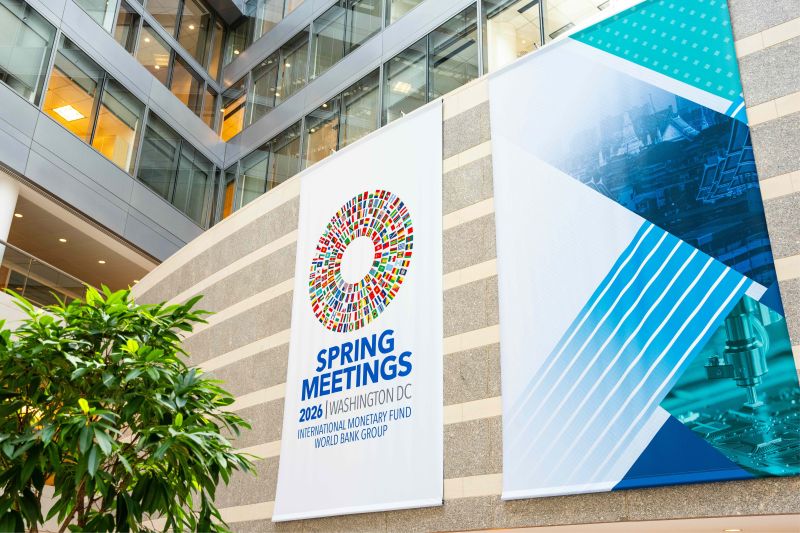
Why Washington’s message this year was not merely about weaker growth, but about the end of easier policy trade-offs.
At the 2026 Spring Meetings, the IMF and the World Bank were not simply presenting forecasts and sectoral priorities. Together, they were signaling a deeper shift in the global policy environment: stability is harder to preserve, growth is harder to generate, and prosperity increasingly depends on whether countries can combine macroeconomic credibility with institutional delivery.In that sense, the real lesson from Washington was not only economic. It was strategic (IMF, 2026a; World Bank Group, 2026a).
Why this year felt different?
Washington’s Spring Meetings this year did not feel like a routine gathering of multilateral institutions. They felt like an inflection point. The world economy had already been carrying the weight of trade tensions, slower momentum, and fragile confidence. Then came the war shock in the Middle East, and with it a sharper realization that the global policy debate has changed. The central issue is no longer simply how to restore growth after disruption. It is how to preserve stability, sustain legitimacy and still deliver development in a world where shocks arrive faster, overlap more often, and pass more directly into prices, markets, and politics. That, in my view, was the real context of Spring Meetings 2026 (IMF, 2026a; IMF, 2026b).
The IMF’s message: Prudence in a harsher world
The IMF’s message was sober and unmistakable. In its April 2026 World Economic Outlook, the Fund projects global growth at 3.1% in 2026 and 3.2% in 2027, while also warning that global headline inflation is expected to rise modestly in 2026 before resuming its decline in 2027. More importantly, the IMF makes clear that pressures are concentrated in emerging market and developing economies, especially commodity importers with preexisting vulnerabilities, and that risks are decisively on the downside. This is not merely a downgraded forecast. It is a warning that the world economy is once again confronting the most difficult macroeconomic combination: weaker growth together with renewed inflationary pressure (IMF, 2026a).

This changes the meaning of prudence. In easier times, policymakers can afford to separate macroeconomic stabilization from social support, or to treat fiscal discipline as a medium-term issue that can wait for calmer conditions. In the environment described by the IMF, that luxury has largely disappeared. The Fund’s pre-Meetings signal was explicit: central banks should remain committed to price stability, while fiscal authorities should providetargeted and temporary support to the vulnerable, consistent with medium-term fiscal frameworks. Beneath that technical language lies a larger truth: policy space is no longer abundant, and governments will increasingly be judged by whether they can make difficult choices without losing credibility (IMF, 2026b).
The World Bank’s message: Prosperity as execution
The World Bank came to Washington with a different emphasis, but not a different reality. Its Spring Meetings platform was organized around the theme“Building prosperity through policy.” That phrasing matters. It suggests that prosperity is no longer being discussed mainly as an aspiration, but as a matter of execution. The Bank’s public agenda placed the focus on one central challenge: creating jobs and driving growth through better policies, and on how policy reform, partnerships, and data-driven tools can translate into real-world impact. This is a development message, certainly, but it is also a political economy message: in the coming period, institutions will not be judged by the ambition of their statements, but by their ability to produce outcomes (World Bank Group, 2026a).

That is why the World Bank’s agenda deserves to be read carefully. Its Spring Meetings recap emphasized practical approaches to creating jobs at scale, unlocking private sector participation, and delivering measurable results across countries and sectors. In other words, the Bank is advancing a more integrated and operational understanding of development. Growth is not being presented as a by-product of broad goodwill or external financing alone. It is being framed as the result of institutions capable of converting policy into jobs, investment, services, and accountability. This is, in many ways, the Bank’s most important message: the challenge is no longer defining the right aspirations, but building the machinery to deliver them (World Bank Group, 2026a; World Bank Group, 2026b).
How the two institutions complement each other?
Seen separately, the IMF and the World Bank appear to be speaking in different dialects: one of inflation, interest rates, fiscal buffers and downside risks; the other of jobs, sectors, private participation and implementation. Seen properly, however, they are describing the same world from two essential angles. The IMF is defining the constraints. It is telling governments that the external environment has become harsher, buffers thinner, and mistakes more costly. The World Bank is defining the task. It is telling them that, under exactly those constraints, progress will depend on their ability to deliver results in the real economy. Stability without delivery leads to stagnation. Delivery without stability leads to frustration and eventual reversal. That is why the two messages are more complementary than separate (IMF, 2026a; IMF, 2026b; World Bank Group, 2026a).
What they have in common?
There is also an important common thread running through both institutions’ positions:the age of compartmentalized policy is over. Energy is no longer just an infrastructure topic; it is also a growth, inflation, and security issue. Social protection is no longer only a welfare tool; it is part of the political sustainability of adjustment. Digital systems are no longer an administrative modernization project; they are becoming central to service delivery, transparency, and productivity. And jobs have emerged as the bridge concept linking macroeconomic order to social legitimacy. The World Bank says this explicitly through its program design; the IMF implies it through its insistence that stability must be preserved if incomes and livelihoods are to improve durably (IMF, 2026b; World Bank Group, 2026a; World Bank Group, 2026c; World Bank Group, 2026d).
My view: Encouraging, but cautionary
My own conclusion from Spring Meetings 2026 is both encouraging and cautionary.It is encouraging because the international policy conversation has become more realistic. There was less complacency in Washington this year, less faith in easy solutions, and more recognition that prosperity now depends on a tighter combination of discipline, capability, and delivery. That is a healthier starting point than the illusion that one can borrow, subsidize, stimulate, and reform all at once without real trade-offs (IMF, 2026a; IMF, 2026c; IMF, 2026d).
But it is also cautionary because the prescriptions emerging from Washington, while sound in principle, remain far easier to state than to execute. It is one thing to advocate targeted support, credible frameworks, private-sector participation, measurable outcomes, and stronger institutions. It is another to achieve these in countries where administrative capacity is limited, political coalitions are fragile, and social tolerance for adjustment is weak. The real challenge ahead will not be analytical. It will be institutional and political.Many countries do not suffer from a shortage of advice; they suffer from a shortage of implementable state capacity. That gap deserves far more attention than it usually receives in multilateral discourse. This final judgment is my own, but it follows from the evident tension between increasingly demanding policy prescriptions and the uneven governance realities in much of the developing world (IMF, 2026b; World Bank Group, 2026a).
Looking ahead
Looking ahead, I believe the next phase of global policymaking will be defined by a more demanding test than simple resilience. Countries will need to preserve macroeconomic credibility, maintain social legitimacy and build institutions capable of delivery at the same time. Those that manage to do so will not merely survive volatility; they will emerge stronger from it. Those that fail may remain trapped in a cycle of recurring stabilization without genuine transformation. The deeper lesson of Spring Meetings 2026, then, is not simply that the world economy is weaker. It is that prosperity now requires a more serious state, a more disciplined policy framework and a much greater capacity to turn strategy into outcomes. In the years ahead, that combination will matter more than any slogan (IMF, 2026a; IMF, 2026b; World Bank Group, 2026a).
References
International Monetary Fund. (2026a). World economic outlook, April 2026: Global economy in the shadow of war. IMF.
International Monetary Fund. (2026b, April 9). Cushioning the Middle East war shock. IMF.
International Monetary Fund. (2026c). Fiscal policy under pressure: High debt, rising risks. IMF.
International Monetary Fund. (2026d, April 15). War shock requires disciplined fiscal reaction. IMF Blog.
International Monetary Fund. (2026e). Global financial stability report, April 2026: Global financial markets confront the war in the Middle East and amplification risks. IMF.
World Bank Group. (2026a, April 13–18). 2026 Spring Meetings: Building prosperity through policy. World Bank Live.
World Bank Group. (2026b, April 13). Ajay Banga on the World Bank Group’s jobs agenda at the Atlantic Council. World Bank Live.
World Bank Group. (2026c). Spring Meetings 2026: Driving growth and jobs through energy. World Bank Live.
World Bank Group. (2026d). Spring Meetings 2026: Unlocking women’s economic power. World Bank Live.
World Bank Group. (2026e). Spring Meetings 2026: Water Forward – Driving jobs and prosperity. World Bank Live.
World Bank Group. (2026f, April 15). World Bank Group launches initiative to improve water security for 1 billion people. World Bank Group.
Linkedin:
